When someone asks ChatGPT "best realtor in [your city]" or Perplexity "top dentist near me," three businesses get named. Right now, it's probably not you. SEARCHRIFT™ shows you exactly why — and delivers the code to fix it.
Built for real estate, restaurants, and professional services in competitive markets.
When buyers ask AI "best buyer's agent in [city]," AI draws from sites with structured service pages, neighborhood content, and local schema. If yours lacks them, you are not named.
"Best Italian near me" or "romantic dinner downtown" pulls from structured menus, FAQ sections, and review signals tied to a complete Google Business Profile.
For "business attorney near me" or "CPA for small businesses," AI favors firms with clear service pages, Q&A content, and visible credentials — not whoever bought the most ads.
Dentists, HVAC, plumbers, consultants, local retail, SaaS tools. If a customer can ask AI to recommend one, you need to be in the recommendation.
Since July 2025, Cloudflare has blocked AI crawlers by default on new domains. That block operates independently of your robots.txt. A site with clean SEO, strong content, and full schema can still be completely citation-blocked by ChatGPT, Claude, and Perplexity without its owner knowing. Every SEARCHRIFT audit tests both robots.txt and Cloudflare. If GPTBot, ClaudeBot, or PerplexityBot is blocked, it appears as the first finding in your report — before anything else.
Your website has a “do not enter” sign hanging on its door that you never put there. The sign was added automatically by the company that protects your site from spam and hackers. It keeps the bad guys out, but it also keeps ChatGPT, Claude, and Perplexity out — which is why they do not recommend you when your customers ask.
The fix takes about two minutes. You just have to know it is there.
Google still matters. But ChatGPT, Perplexity, and AI Overviews now answer questions directly — without clicking through to your site. Businesses that are not structured to be cited by those systems are losing customers they cannot see leaving.
When someone asks ChatGPT or Perplexity "best [your service] near [city]", those systems synthesize an answer from structured, authoritative sources. If your site lacks answer capsules, entity markup, and FAQPage schema, you are not in the candidate pool — regardless of your Google ranking.
Google's Featured Snippets, People Also Ask boxes, and voice search results extract answers from pages with specific structural signals. Without question-format headings, properly formatted FAQ schema, and 40–90 word direct answers, Google picks your competitor's page instead of yours.
FAQPage schema, structured answer blocks, and question-format headings improve both GEO and AEO simultaneously. Most businesses have none of them. The competitive window to own AI-cited visibility in your market is right now — before your competitors discover this.
A page-one Google ranking does not guarantee citation by an AI engine. GEO has no ranking dependency — AI systems can cite any source, anywhere, that is authoritative and structurally readable. A well-optimized page 3 result can outperform your page 1 competitor in AI results.
AI systems learn from what they cite. The business that gets mentioned in AI answers this month gets mentioned more next month. The gap is not static — it compounds.
When ChatGPT or Perplexity first names your competitor, that recommendation becomes a signal for future responses on the same topic.
Each citation drives brand searches, site visits, and reviews. That activity signals legitimacy, which drives more citations.
After six months of citation history, your competitor becomes the default recommendation. New entrants need significantly more effort to displace them.
When someone asks "best plumber near me" and gets three recommendations, yours is not one of them. That customer calls someone else and never learns you exist.
As more customers use AI instead of Google, your Google Ads reach fewer people. You pay more for less traffic from a shrinking pool.
900 million weekly ChatGPT users as of Feb 2026, doubled from 400 million a year earlier (OpenAI). Gartner forecasts a 25% drop in traditional search volume by end of 2026 (Feb 2024 prediction).
Open ChatGPT, Perplexity, or Google AI right now. Paste one of these queries with your actual city and service. Read what the AI says back. If your business is not named, you are invisible to that buyer.
We do not promise specific revenue outcomes. We cannot. What we can do is show you how to frame the stakes honestly for your own business using numbers you already know.
| Input | How to Estimate |
|---|---|
| Your average closed deal value | You know this number from your own books. |
| Deals you close per month from search | Count your pipeline by source for a typical month. |
| Share of discovery moving to AI | Gartner forecasts a 25% decline in traditional search volume by end of 2026 (Feb 2024 prediction). Use that as an upper bound. |
| Your rough exposure | Multiply: deals per month × deal value × AI share. That is roughly what is in play if you stay invisible. |
Most practitioners conflate GEO and AEO. They are distinct, require different fixes, and together cover every AI-powered search surface your customers use.
GEO is about being cited in synthesized AI answers. When an AI platform generates a response, it draws from sources it can parse, verify, and attribute. The goal is not a click — it is a citation.
AI systems favor brands with editorial presence, structured answer content, entity-level descriptions, and FAQPage schema that can be understood without surrounding page context.
AEO is about winning Google's own answer features: Featured Snippets, People Also Ask boxes, and voice search. These extract directly from your page — or your competitor's.
Unlike GEO, AEO has a ranking dependency: your page must rank on page one for Google to consider it for extraction. On-page structure and FAQPage schema are the primary levers.
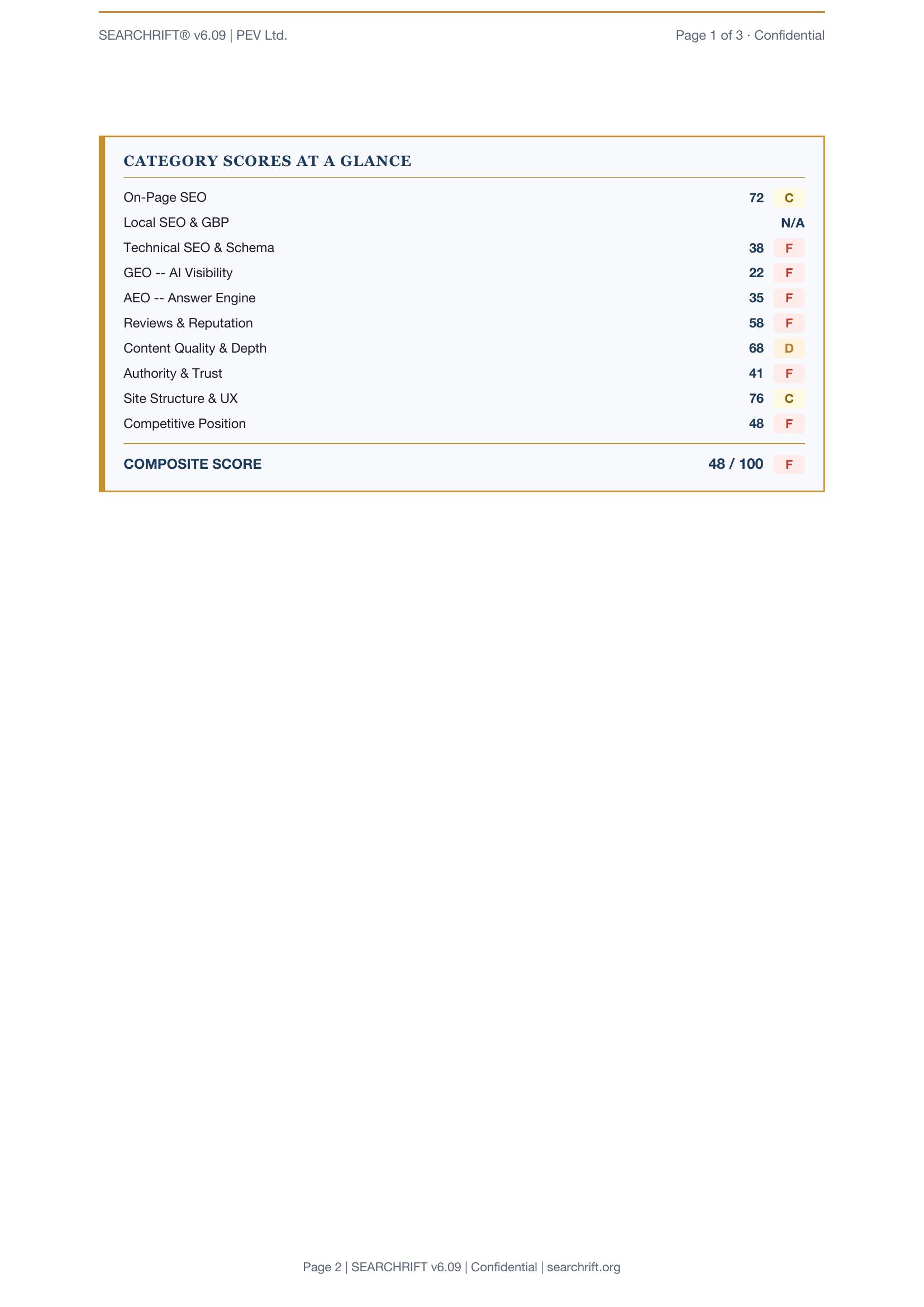
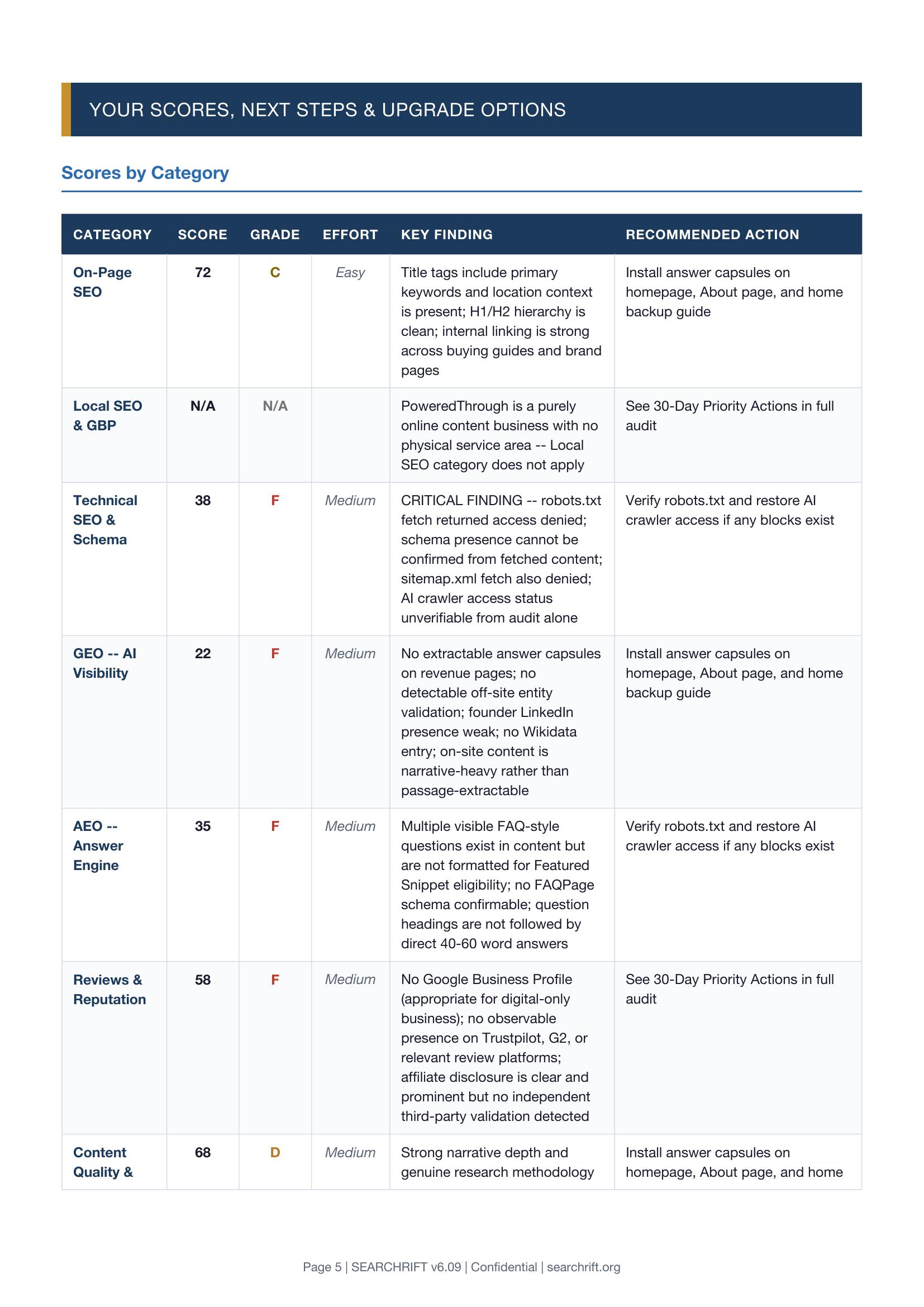
Every audit scores your site on the ten categories that actually matter for AI visibility. Each one is graded 0–100, calibrated against three to five named competitors in your market. No generic benchmarks, no industry averages — real scores against real businesses you actually compete with.
Title tags, meta descriptions, heading structure, alt text, URL structure, internal linking.
Google Business Profile completeness, NAP consistency, Map Pack presence, service-area pages.
Schema markup correctness, sitemap, HTTPS, mobile, crawlability, AI crawler access check.
Answer capsules, passage extractability, entity blocks, editorial presence, founder markup.
Featured Snippet eligibility, PAA coverage, question-format headings, HowTo schema.
Total count, average rating, velocity, response rate, review request process versus competitors.
Service depth, front-loaded answers in the first 30% of pages, update cadence, dateModified signals.
Off-site citation presence, Wikidata, Knowledge Panel, press mentions, entity disambiguation.
Navigation clarity, mobile experience, primary CTA, forms, booking integration, accessibility.
Market-calibrated view against three to five named competitors. Honest read on who is winning and why.
Only 11% of domains are cited by both ChatGPT and Perplexity. Each platform has its own retrieval conditions and source preferences. Every SEARCHRIFT audit includes a Platform Signal Summary showing your specific gaps on each one.
Weights brand search volume, Bing-indexed pages, Wikidata presence, and established brand mentions. 92% of ChatGPT search queries run through Bing's API.
Favors sources it can retrieve, parse, trust, and cite cleanly. Passage extractability matters more than freshness for most queries. Reddit signals matter for consumer/comparison queries.
Favors multi-source corroboration and diversified presence. 62% of AI Overview citations come from outside the top 10 organic results. LinkedIn, YouTube, and Reddit feature prominently.
Platform signal assessments are based on published citation research at time of audit. Live citation testing across AI platforms is a separate service (Citation Baseline Test) available on request.
AI systems decide whether to cite you by cross-referencing what you say on your site against what independent sources say about you elsewhere. The off-site layer is where most audits stop looking. SEARCHRIFT checks all of it.
Completeness, NAP consistency across directories, Map Pack presence, review velocity, response rate, category accuracy.
Wikidata entry, Knowledge Panel, LinkedIn company activity, press mentions, directory listings, review platforms.
Does your business name resolve cleanly? Same-name conflicts? Profile agreement across GBP, LinkedIn, directories, Wikidata?
Founder credentials, professional background, Person schema, LinkedIn alignment. AI systems cite people, not just companies.
Presence and activity on the review sites your buyers actually check: Google, Trustpilot, G2, Capterra, Clutch, Yelp, industry-specific.
Last meaningful update on homepage, service pages, pricing, FAQ. Recency matched to topic volatility. No cosmetic timestamp edits.
Free AI audit tools scan your page, output a score, and disappear. They don’t calibrate against your actual competitors, don’t check off-site signals, and don’t produce anything you can install. Here is the difference, plainly.
| Free AI Grader | SEARCHRIFT | |
|---|---|---|
| Calibrated against named competitors | – | 3–5 competitors, market-specific |
| AI crawler & Cloudflare check | – | Full check on every audit |
| Off-site citation presence | – | Wikidata, LinkedIn, press, directories |
| Platform-specific gap analysis | – | ChatGPT, Perplexity, Google AI |
| Inference discipline (cites unverifiable findings) | – | Every inferred finding labeled |
| Ready-to-install fixes in correct order | – | START_HERE install sequence |
| 90-day re-audit to measure change | – | Included as paid add-on |
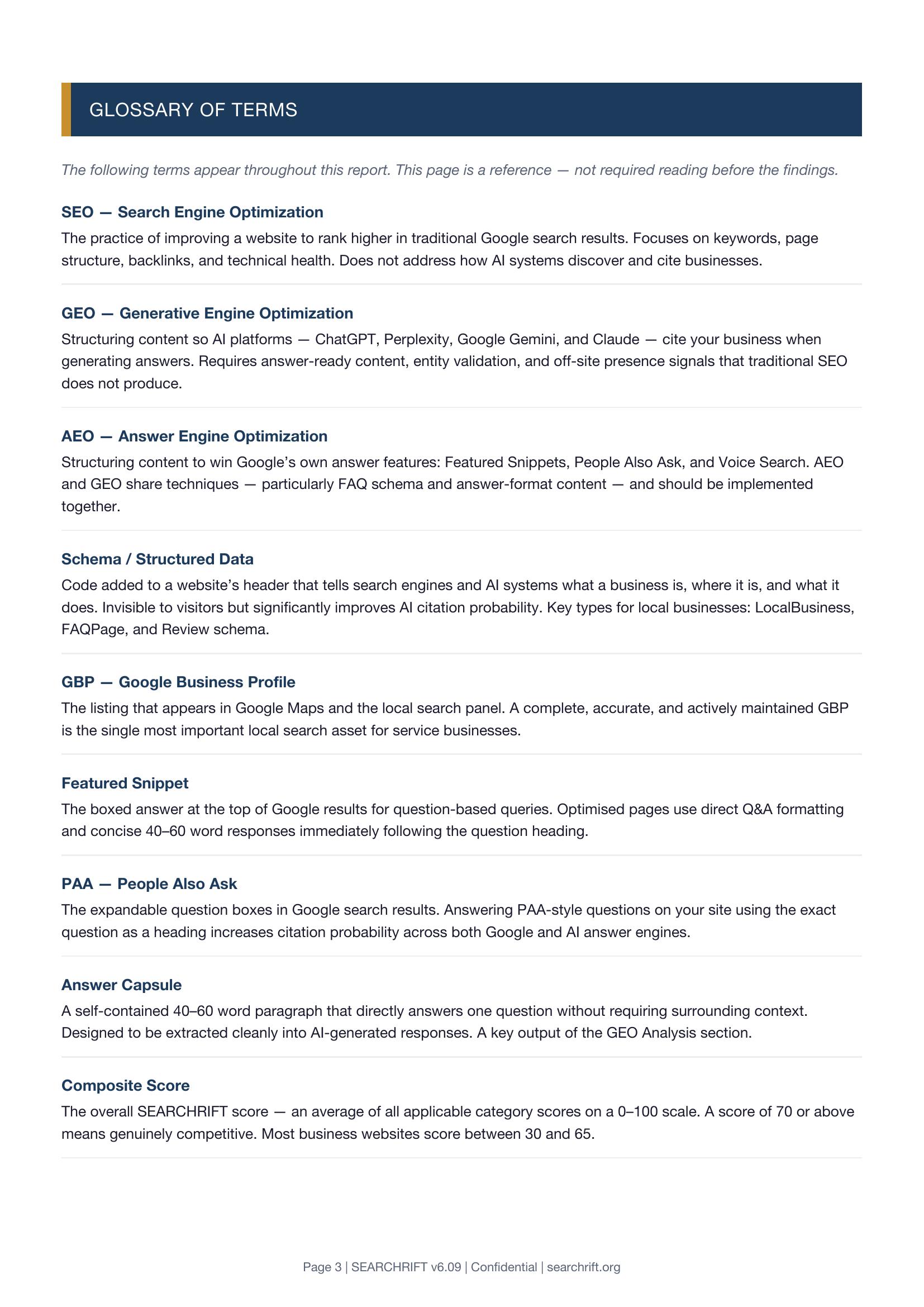
Every audit follows the same format. Here's a real example showing what we found for a dental practice in Phoenix and how we scored them across all ten categories.
The audit identifies the problems. The code package gives you the solutions — written, tested, and sequenced so you install them in the order that actually works. Every file is custom-built for your specific business from your audit findings. Not industry templates. Not generic placeholder copy. Your domain, your services, your founder, your competitors, your gaps.
Your install order, verification checklist, back-up instructions, platform-specific notes (WordPress, Squarespace, Wix, Shopify, Webflow, custom), and a “What Can Go Wrong” troubleshooting table. You install one fix at a time, verify it works, then move on. No developer required for Easy and Medium rated fixes.
Every package includes a ready-made AI prompt written to walk you through install step-by-step. Paste it into the AI of your choice — we recommend Claude or Perplexity — along with the audit finding you’re working on, and you get a private assistant that knows your site, your CMS, and what “done” looks like. No more Googling error messages.
Corrected robots.txt removing any blocked AI crawlers, plus explicit Cloudflare dashboard instructions if your site uses it. Both layers must pass before GEO work has full effect.
A forward-compatible guidance file for AI crawlers. Zero risk, zero cost. Positions your site correctly as the standard matures. Not an active citation driver today — honest framing included.
Complete JSON-LD for your business type: Organization, LocalBusiness, Service, FAQPage, and Person markup for founders and key team members.
Title tags and meta descriptions written to win Featured Snippets and AI citations. Primary pages plus templates for service and location pages.
Question-and-answer content written for your industry, structured for both human readers and AI parsing. Ready to publish with schema markup included.
Self-contained 40–60 word answer blocks for every citation-weak page in your audit. Written to AI citation standards. Not just three — one per flagged page.
Featured Snippet copy blocks engineered to win Google's answer features. Primary service snippets plus templates for common customer questions.
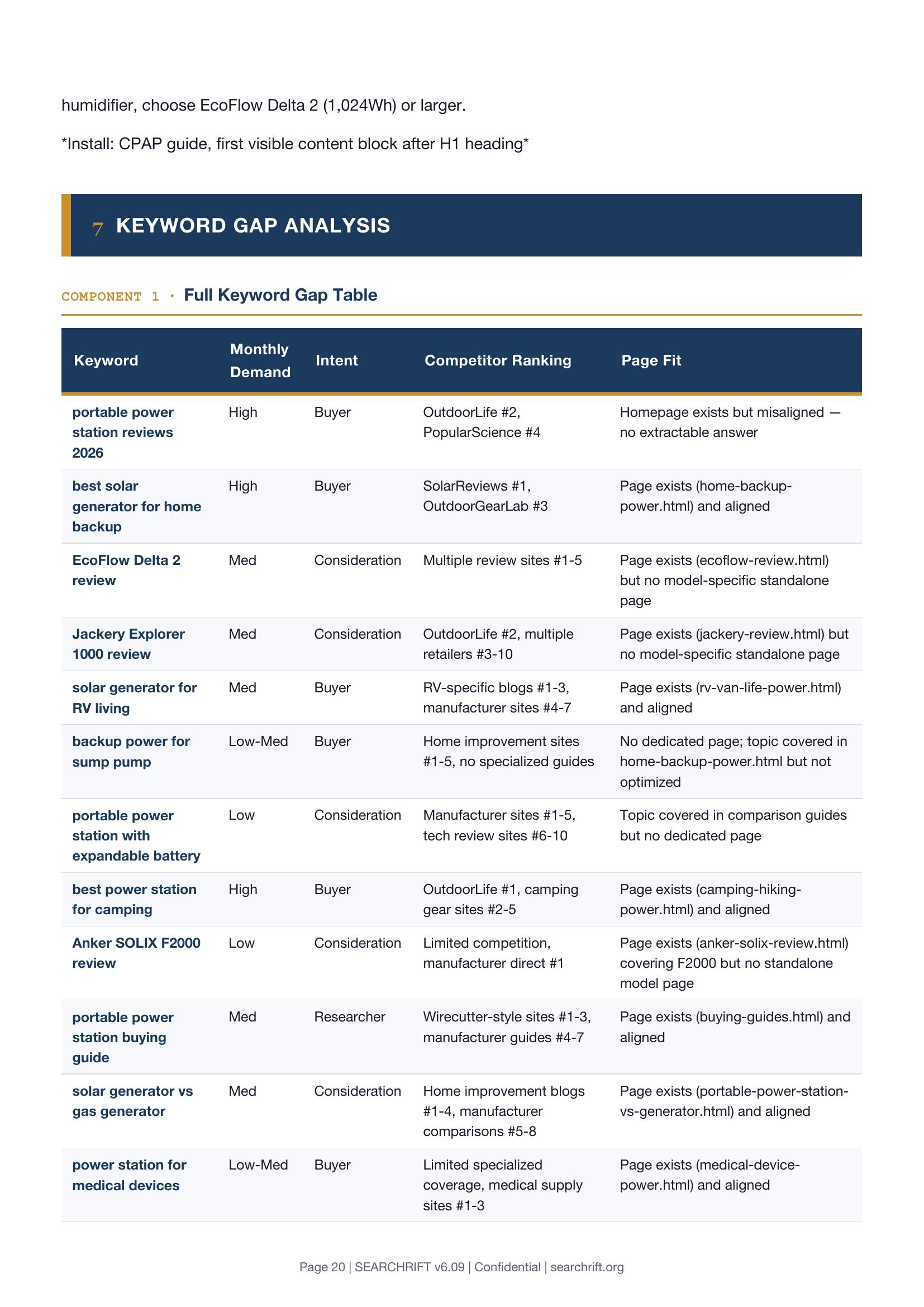
New page starters for gaps where no page exists, plus alignment briefs for pages that exist but do not match their target query. Buyer-intent keywords prioritized.
Per-page guidance for stale content: what to update, dateModified markup to add, recommended cadence by page type. If your content is fresh, the file says so.
Three email/SMS templates for requesting reviews from recent customers. Platform-specific for Google, Yelp, Trustpilot, or G2 based on your industry.
Entity disambiguation check plus prioritized PR angles: Wikidata, Knowledge Panel, review platforms, press mentions. Advisory — does not touch your website.
A brief for a single short video that addresses the highest-impact gap in your content. YouTube is a primary signal for Google AI Overviews. Advisory — does not touch your website.
No subscriptions. No ongoing fees. Pick the level of help you want and move on. Not sure where to start? Most SMBs buy the Audit + Package.
Here's what business owners typically want to know before ordering their audit.